
ECG / Long-Term ECG
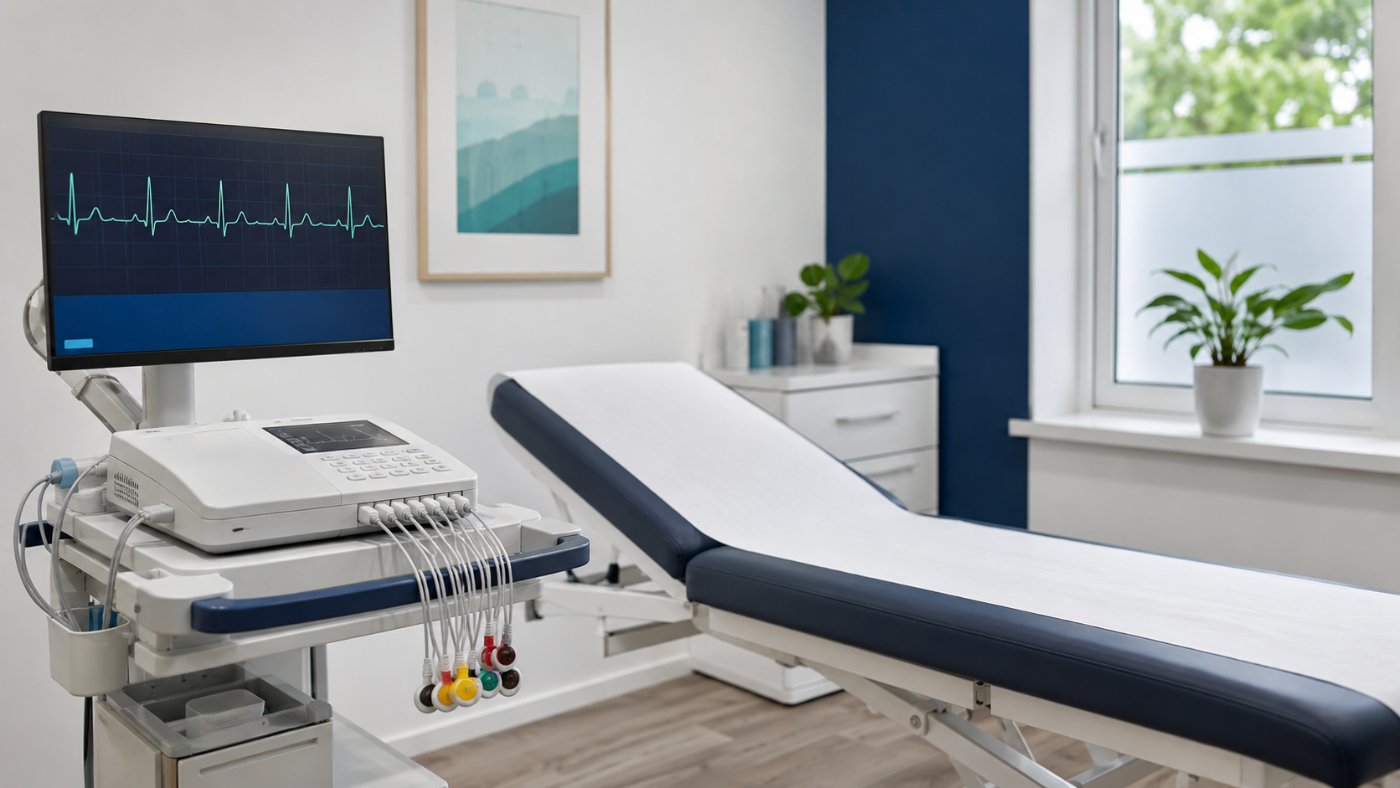
Cardisiography – modern heart diagnostics with AI support
Assessing heart health early and precisely
At our practice we offer cardisiography as a modern addition to cardiac diagnostics. The heart's electrical signals are recorded within a few minutes and then evaluated with an AI-supported analysis.
The examination can give indications of irregularities in heart function and helps us decide whether further cardiological investigation is advisable.
How does the examination work?
The measurement is quick, painless and involves no radiation. Electrodes are attached to the upper body and record the heart's electrical signals for a short time. The computer-assisted analysis follows.
Your advantages:
• examination in a few minutes
• painless and non-invasive
• no radiation exposure
• AI-supported analysis of the heart signals
• carried out directly in our family practice
• an additional aid in deciding whether further cardiological diagnostics are needed
Who might cardisiography be suitable for?
An examination may be considered, for example, for unclear cardiac symptoms, symptoms under exertion, or for an extended assessment of the heart. Whether cardisiography makes sense in your individual case is something we are happy to discuss with you personally.
Important: cardisiography complements the medical examination and established diagnostic procedures. Where there is a corresponding suspicion, it does not replace the necessary further cardiological diagnostics.
Interested in cardisiography?
Please speak to our practice team. We will tell you about the procedure, the medical suitability and the cost of the examination.
Hausarztpraxis in der Neustadt – Yousif Khalaf Al-alwani
Comprehensive Heart Rhythm Analysis
Our ECG and Long-Term ECG services offer a detailed window into your heart's electrical health. While a standard electrocardiogram provides a vital snapshot of your heart at rest, many irregularities only appear during the stresses and movements of your daily life. By utilizing advanced long-term monitoring—such as Holter monitors—we can record your heart's rhythm over 24 hours or more.
The Standard ECG: The Vital Baseline
A standard ECG is a quick, non-invasive test that records the electrical signals in your heart. It is the gold standard for a first-line assessment because it can instantly show:
• Heart Rate and Rhythm: Whether your heart is beating too fast, too slow, or irregularly.
• Heart Attack Evidence: Signs of previous heart damage or an ongoing event.
• Structural Abnormalities: Clues regarding thickened heart walls or chamber enlargement.
Why long-term?
Some heart symptoms are like "ghosts"—they come and go unexpectedly. If you experience palpitations, dizziness, or chest pain that doesn't happen while you are sitting in the doctor's office, a Long-Term ECG is necessary.
• 24 to 72 Hour Tracking: The device stays with you as you work, exercise, and sleep.
• Symptom Correlation: You can press a button or keep a diary when you feel a symptom, allowing the doctor to see exactly what your heart was doing at that precise moment.
• Catching "Silent" Issues: It can detect arrhythmias like Atrial Fibrillation (AFib) that might occur briefly without you even feeling them.
How it Works: Seamless & Painless
• Placement: Small, sticky sensors (electrodes) are placed on your chest and connected to a lightweight, portable recorder.
• No Interruption: The device is small enough to be worn under your clothes, allowing you to go about your day as usual.
• Detailed Reporting: Once the monitor is returned, our specialists analyze thousands of heartbeats to provide a comprehensive report on your cardiac performance.
Stress ECG (Ergometry)
Your heart health under examination. A stress ECG shows us how your heart and circulation respond to physical exertion. Often, abnormalities (such as circulation disorders or arrhythmias) only become apparent when the body is challenged.
Why a stress ECG?
• Early Detection: Suspected narrowing of the coronary arteries (CHD/CAD).
• Blood Pressure Check: Assessment of blood pressure behavior under physical exertion.
• Performance Diagnostics: Assessment of physical fitness (e.g., following an illness or for sports beginners).
• Therapeutic Success: Monitoring the effectiveness of heart or blood pressure medications.
Sequence of Events
You are pedaling on a stationary bike (ergometer). The resistance is increased step by step, while we continuously record your ECG and regularly measure your blood pressure.
Important for you: Please bring comfortable clothing (sportswear or loose-fitting trousers) as well as sturdy shoes. Plan approximately 20 to 30 minutes for the examination, including preparation and follow-up.